

Net Zero Scotland Projects Conference 2026
12th Annual Conference
Where Policy Becomes Projects, and Projects Become Delivery
The 12th Annual Net Zero Scotland Projects Conference is Scotland's national public-sector net-zero project-delivery conference.
Hosted at Dynamic Earth in Edinburgh, the conference brings together pre-qualified public-sector project owners with private-sector organisations capable of supporting the delivery of net-zero projects across buildings, estates, housing, heat, energy, transport and infrastructure.
The conference is being delivered in association with the Scottish Procurement Alliance, supporting stronger collaboration between Scotland's public-sector project owners, procurement communities and private-sector delivery partners.
The programme is designed around current and upcoming projects, typically within a 0 to 18-month delivery window. This is not a trade fair or a volume-led exhibition. It is a curated, delivery-focused conference built around real projects, real funding, practical collaboration and measurable outcomes.
Why This Event Matters in 2026
Scotland is entering a decisive delivery phase.
Policy, public investment, procurement and private-sector capability must now connect around practical delivery.
Scotland's Climate Change Plan 2026 to 2040 sets out more than 150 actions across buildings, energy, transport, industry, land use and communities. The plan estimates that climate action could generate £42.3 billion in financial benefits and cost savings across the Scottish economy between 2026 and 2040.
Scotland has already reduced greenhouse-gas emissions by 51.3% between 1990 and 2023. The focus is now shifting from long-term strategy towards large-scale delivery across homes, public-sector estates, infrastructure, transport systems and communities.
Public funding alone will not deliver change at the pace and scale required. Success will depend on stronger collaboration between public-sector project owners, private investment, technical specialists, technology providers, contractors and programme-delivery organisations.
Where demand is growing
Policy, Funding and Project Signals
Scotland's Net Zero Project Pipeline
Scotland is moving from long-term climate ambition into funded programme delivery across buildings, housing, public-sector estates, heat, energy, transport and infrastructure.
Scotland's Climate Change Plan 2026 to 2040
Scotland's Climate Change Plan sets out more than 150 actions intended to meet Scotland's carbon budgets between 2026 and 2040 and support the national target of net zero by 2045.
The £42.3 billion figure represents forecast financial benefits and cost savings across the Scottish economy between 2026 and 2040. It is not a funding pot or investment commitment. Scotland's greenhouse-gas emissions fell by 51.3% between 1990 and 2023.
- Buildings and low-carbon heat
- Energy generation and infrastructure
- Transport and mobility
- Industry and manufacturing
- Communities and place
- Land use and agriculture
- Public-sector leadership
- Private-sector investment and delivery
This creates significant demand for organisations capable of converting national policy into practical, funded and measurable projects.
£335 Million for Heat in Buildings Programmes
The Scottish Budget for 2026 to 2027 provides over £335 million for heat in buildings programmes.
The investment supports households, businesses and organisations moving towards improved energy efficiency and cleaner heating systems.
- Energy-efficiency improvements
- Clean heating systems
- Heat pumps
- District and communal heat
- Domestic and non-domestic retrofit
- Fuel-poverty reduction
- Technical advice
- Finance and grant support
The investment is creating opportunities for technology providers, installers, building specialists, energy advisers, finance organisations and programme-delivery partners.
The Social Housing Net Zero Heat Fund
Since 2021, the Scottish Government has provided almost £90 million through the Social Housing Net Zero Heat Fund, supporting energy-efficiency and clean-heating improvements across more than 13,000 social homes.
The funding round announced on 6 February 2026 provides more than £19 million to 27 projects supporting approximately 2,300 homes across Scotland.
- External and cavity-wall insulation
- Window improvements
- Individual and communal heat pumps
- Solar PV
- Battery storage
- Clean-heating infrastructure
- Energy-efficiency improvements
- Resident engagement and delivery
The projects are creating demand for housing-stock assessment, resident engagement, installation capacity, programme management and long-term performance monitoring.
Grant Support for Public-Sector Buildings
The Scottish Green Public Sector Estate Decarbonisation Scheme supports public bodies delivering building-energy and heat-decarbonisation projects. Phase 3 of Scotland's Public Sector Heat Decarbonisation Fund launched on 2 March 2026.
- 80% for local authorities
- 80% for universities
- 80% for arm's-length external organisations
- 100% for eligible central-government organisations without access to borrowing
- Whole-building decarbonisation
- Heating-system replacement
- Controls and renewable generation
- Estate-wide project delivery
The programme creates direct opportunities across local authorities, universities, government assets and wider public-sector estates.
Scotland's Heat-Network Project Pipeline
More than £62 million in grant funding has been awarded through Scotland's Heat Network Fund and its predecessor, the Low Carbon Infrastructure Transition Programme.
Scotland's Heat Network Fund has awarded approximately £14.5 million to seven projects and has been extended until at least 2030. The Heat Network Support Unit has supported 55 pre-capital projects across 18 local-authority areas, backed by approximately £3.2 million.
- 2.6 terawatt hours by 2027
- 6 terawatt hours by 2030
- 7 terawatt hours by 2035
- District and communal heating
- Large-scale heat pumps
- Recovered and waste heat
- Project finance
- Network construction and operation
Low-Carbon Transport and EV Investment
The Scottish Budget for 2026 to 2027 includes £85 million for new and continuing low-carbon transport activity, including critical EV-charging infrastructure and the transition towards zero-emission vehicles.
Within this programme, £17.8 million has been confirmed for EV incentives supporting public, workplace and home charging, rural and island infrastructure, households without off-street parking, lower-income households, microbusinesses and third-sector organisations.
Transport Scotland reported more than 12,000 public EV chargers by March 2026. This total includes multiple data sources and should be read with Transport Scotland's published methodology.
The programme creates opportunities across charging infrastructure, fleet transition, depots, energy management, grid connections, software, telematics and zero-emission transport.
What This Means for Project Delivery
The challenge is no longer simply securing policy support.
Taken together, these programmes represent billions of pounds in economic value, public investment, grant funding and private-sector opportunity moving into buildings, housing, heat, energy, transport and infrastructure.
It is ensuring that public-sector organisations have access to the finance, expertise, technology, procurement routes and delivery capacity required to turn this investment into successful projects.
Standards Shaping Decisions
Regulatory Changes Affecting Projects
Building assessment, clean heat and heat-network proposals are changing the evidence, design and delivery decisions organisations need to make now.
EPC Reform in Scotland
Scotland is reforming Energy Performance Certificates for domestic and non-domestic buildings. No new commencement date is confirmed. The current Energy Performance of Buildings (Scotland) Regulations 2008 and the existing EPC system remain in force until further notice.
The proposed reforms include:
- New and clearer rating measures
- Greater focus on building fabric
- Heating-system performance
- Emissions and running costs
- More useful recommendations
- Stronger quality assurance
- Improved calculation methodologies
- Digital data
Organisations are already preparing for more detailed, consistent and data-led building assessment.
View the Official EPC Reform UpdateBuildings, Heating and Heat-Network Regulation
The draft Buildings (Heating and Energy Performance) and Heat Networks (Scotland) Bill sets out proposed directions for decarbonising heat in Scotland's buildings.
- Proposed 2045 clean-heating target
- Minimum energy-performance standards
- Cleaner domestic and non-domestic heat
- Greater heat-network support
- Potential qualifying-building requirements
- Connection or alternative solutions
- Proposed opt-in licensing
- Investor confidence around heat demand
Qualifying buildings may need to decarbonise through a heat-network connection or an alternative solution. Licensing proposals are opt-in. Final content and timing remain subject to decisions by the Scottish Government and Scottish Parliament.
View Scotland's Heat-in-Buildings PlansWhere Organisations Fit
Current Public-Sector Project Priorities
These are the types of current and upcoming projects represented by the conference audience, helping delivery organisations identify a credible place in the conversation.
Public-Sector Estates
Estate-wide decarbonisation, energy management, heat planning, building optimisation, controls and multi-site delivery.
NHS and Healthcare
Complex hospital estates, clean heat, resilience, energy efficiency, infrastructure renewal and live-site delivery.
Universities and Education
Campus energy systems, building retrofit, heat networks, renewable generation, storage and digital optimisation.
Social Housing
Large-scale retrofit, insulation, clean heat, resident engagement, data management and measured performance.
Local Authorities
Civic estates, housing, schools, transport, infrastructure, planning, procurement and place-based delivery.
Heat Networks
District heating, recovered heat, data-centre waste heat, large heat pumps, geothermal energy and commercialisation.
Transport and Fleets
Fleet transition, EV charging, depot infrastructure, HVO, telematics, public transport and operational energy requirements.
Digital Buildings
Controls, monitoring, optimisation, building data, smart estates and measured performance.
Energy and Infrastructure
Solar, storage, grid capacity, flexibility, decentralised energy, utilities and connected infrastructure.
A Curated Project Audience
Who Attends
The event is deliberately structured to create relevant conversations between organisations responsible for projects and organisations capable of supporting delivery.
Public-Sector VIPP Delegates
Public-sector delegates apply through the VIPP Bursary Programme. Applications are assessed according to the delegate's organisation, responsibilities, project involvement, delivery timetable and reasons for attending.
- Local authorities and regional bodies
- Scottish Government departments and agencies
- NHS boards and healthcare estates
- Housing associations and social landlords
- Universities, colleges and education estates
- Transport authorities and regional transport partnerships
- Emergency services
- Publicly owned property and asset organisations
- Community organisations
- Third-sector, charitable and publicly funded organisations
- Public-sector procurement, commissioning and commercial teams
Delegates are responsible for current or upcoming projects, typically within a 0 to 18-month delivery window.
The involvement of the Scottish Procurement Alliance strengthens the conference's focus on practical procurement routes, framework access and the delivery of funded public-sector projects.
Private-Sector Participants
Private-sector participation is controlled and limited to organisations capable of credibly supporting project delivery, including:
- Building-decarbonisation and retrofit specialists
- Heat-pump and low-carbon-heating providers
- Heat-network and decentralised-energy organisations
- Renewable-energy, storage and flexibility providers
- Digital-building, controls and optimisation platforms
- EV-charging, fleet and transport-infrastructure providers
- Alternative-fuel and fleet-decarbonisation organisations
- Finance, funding and programme-delivery organisations
- Engineering, construction and professional-service providers
This approach protects the relevance of the conference for public-sector delegates while creating meaningful engagement for private-sector participants and partners.
Three Sessions: One Shared Programme
The 2026 Conference Programme
Private-sector partners will showcase project case studies, transfer practical knowledge and provide thought leadership across the areas public-sector project owners are working to deliver.
Large-Scale Decarbonisation: Buildings, Estates, Energy and Place
This session will explore the planning, funding and delivery of large-scale decarbonisation projects across domestic, commercial, industrial and public-sector buildings, estates and places.
It will examine how organisations are reducing emissions across complex asset portfolios through retrofit, low-carbon heat, heat networks, decentralised energy, renewable generation, energy storage, digital optimisation and estate-wide programme delivery.
The session will feature projects and delivery challenges across hospitals, universities, housing developments, local-authority estates, commercial buildings, industrial facilities and wider regional infrastructure.
Project and Delivery Priorities
16 TopicsDelivering Decarbonisation: Design, Construction, Retrofit and Technology

This session focuses on the practical delivery of decarbonisation projects.
It will examine how projects are designed, specified, procured, constructed, installed, integrated and measured across complex buildings, estates and infrastructure.
The session will explore how organisations can overcome technical, financial and operational barriers while adopting innovative technologies and closing the gap between design intent and real-world performance.
The keynote contribution from the Scottish Procurement Alliance will help frame the role of procurement, frameworks and public-private collaboration in turning net-zero ambition into deliverable projects.
Project and Delivery Priorities
18 TopicsConnected Places: Energy, Infrastructure and Mobility
This session will explore how buildings, heat, power, transport, data and infrastructure can be connected to create resilient, efficient and low-carbon places.
It will focus on the integration of energy systems, public estates, transport networks, digital technologies and wider infrastructure, supported by practical investment, procurement and delivery models.
The session will examine how individual projects can be connected and scaled across towns, cities, regions, campuses, rural communities and major public-sector estates.
Project and Delivery Priorities
16 TopicsParticipation Routes
Public-Sector and Private-Sector Participation
Two clearly controlled routes protect the quality of the audience and help every organisation understand how to take part.
For Public-Sector Project Owners
Eligible public-sector, third-sector, charitable and publicly funded organisations can apply for a bursary-funded VIPP place.
- Access to all conference sessions
- Access to the Networking Zone
- Five-star buffet lunch and refreshments
- Post-event Video on Demand
- Inclusion in the GDPR-compliant delegate network where consent is provided
- The opportunity to invite relevant colleagues
For Private-Sector Organisations
Private-sector organisations can participate through a limited delegate ticket or an official event partnership. Delegate tickets provide access to the conference and networking environment.
- Speaking and case-study opportunities
- Panel participation
- Exhibition presence
- Thought-leadership positioning
- Year-round Net Zero Club visibility
- GDPR-compliant post-event delegate information where consent has been provided
Why Attend
Designed Around Delivery Value
A focused day for understanding the pipeline, sharing practical experience and building the relationships required to move projects forward.
Engage with Qualified Project Owners
Meet public-sector professionals directly responsible for current and upcoming projects across buildings, estates, housing, heat, energy, transport and infrastructure.
Understand Where Funding Is Moving
Explore the policies, programmes, regulations and investment signals creating project pipelines across Scotland.
Learn from Real Delivery Experience
Hear practical case studies addressing funding, procurement, design, construction, retrofit, technology integration, infrastructure and measured performance.
Explore Connected Project Opportunities
Understand how buildings, heat, energy, transport, data and infrastructure can be planned and delivered as connected systems.
Build Relevant Public-Private Relationships
Develop relationships between public-sector project owners and organisations capable of supporting project delivery.
Reduce Delivery Risk
Learn what is working, what is not working and how other organisations are overcoming common project barriers.
Understand Procurement and Framework Routes
Explore how procurement strategy, frameworks, commercial models and supply-chain engagement can help public-sector organisations move projects from planning into delivery.
See the Conference in Action
More Than a Decade of Practical Conversations
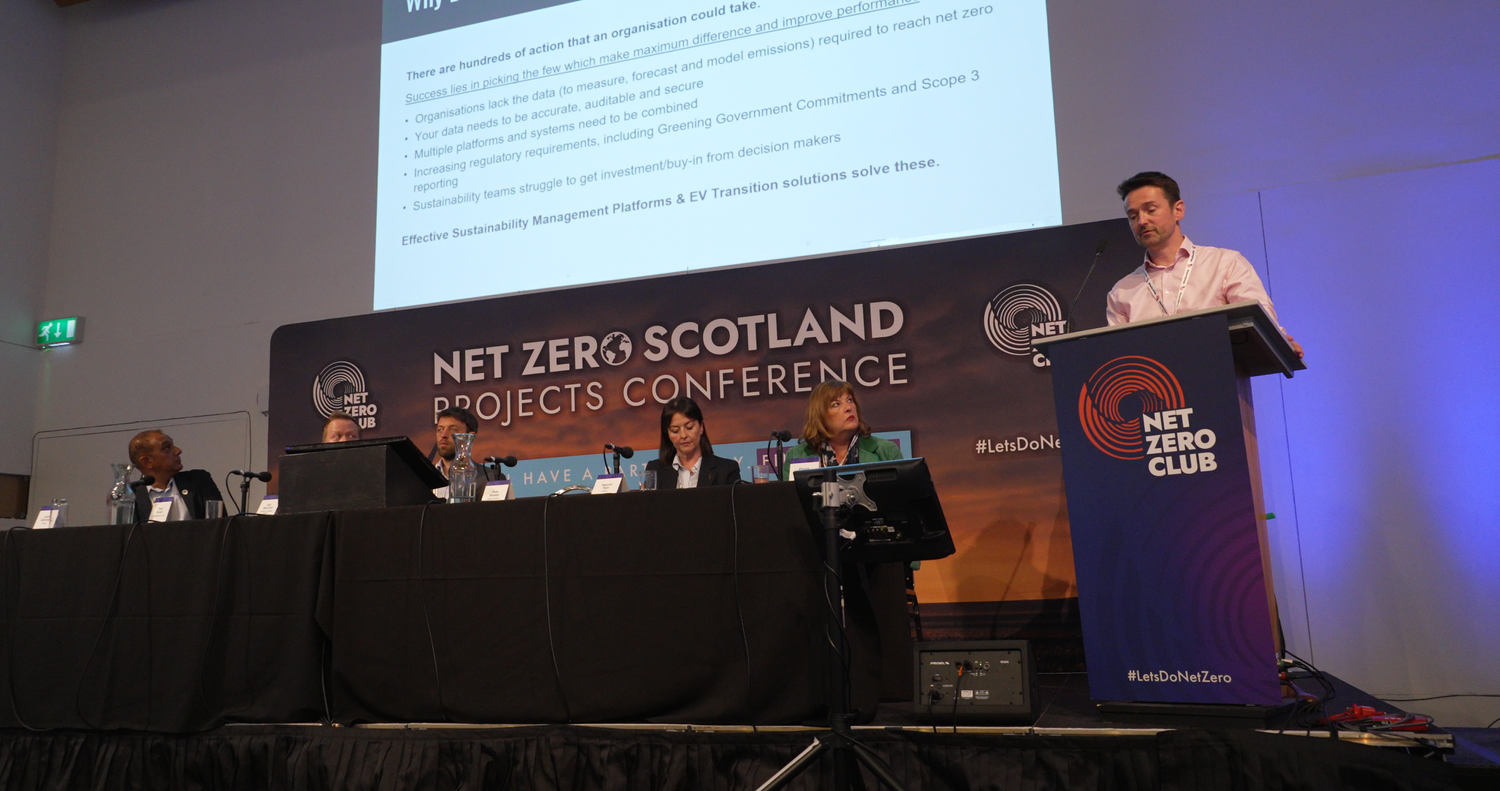
The Net Zero Scotland Projects Conference has brought Scotland's public and private sectors together for more than a decade. Previous presentations, interviews and panel discussions demonstrate the practical, project-led nature of the programme.

Supporting Brands and Credibility
Supporting Organisations
Three clearly defined relationships strengthen procurement, knowledge exchange and year-round engagement while keeping the event identity clear.



Get Involved. We All Have a Part to Play.
Join the Organisations Turning Scotland's Net-Zero Policy into Deliverable Projects
If you are responsible for delivering, funding or enabling net-zero projects across public-sector estates, buildings, housing, heat, energy, transport or infrastructure, the Net Zero Scotland Projects Conference provides a focused environment for knowledge exchange, project collaboration and practical delivery.
